Heltevei
Overview
The southern regions of Ursal have largely converted to The Fayth, but those in the colder, harsher north subscribe to Heltevei, an evolution of early paganism, intermingled with ideas from The Fayth given the latter's continental prominence.
Like The Fayth, Heltevei follows a single god - the feminine divine Helligmor, mother to all, believed to be an evolution of the old pagan goddess Dagmar, a fertility goddess associated with the sun. Helligmor retains this solar link, and her followers wear a sunburst as their holy symbol.
Helligmor has an adversary too, much like God and the Devil: Helligfar, the moon - not deemed Evil himself, though his lunar association carries hangover associations from the old war god Bori. Helligmor and Helligfar are wife and husband, who brought the world into existence together - until Helligfar was bitten by a snake born of its own Evil will, and twisted by the venom. This has led to the long superstition that snakes are viewed as unlucky and considered vermin to be killed on sight.
To protect the world from his rage, Helligmor cast him off it, where he became the moon. The two remain locked in a cycle; prophecy holds that when they meet in eclipse, it will herald an era of despair.
A key divergence from The Fayth is Heltevei's focus on ancestor worship, carried forward from its pagan roots in hero worship. Those who achieve great deeds and become famous heroes are deified upon death; the era of raiding heroes has passed, and modern interpretation leans toward leading a Good and pious life honouring Helligmor and the ancestors.
All who follow Heltevei become an ancestor spirit, prayed to for guidance - other gods and goddesses from the original pagan religion persist as ancestors too, though some have fallen into obscurity.

Festivals
Heltevei followers celebrate a series of seasonal festivals, deeply rooted in agricultural cycles and honouring Helligmor's role as sustainer of life.
From the vibrant Spring Equinox to the solemn Winter Solstice, these rituals bring communal bonding, gratitude and renewal.
Most famous is Ursal's Festival of the Sun, a mid-summer celebration of Helligmor during the longest day of the year. Maypole dancing, flower crowns and raucous music is all expected from the festival.
The main event is of the large effigy of the goddess is constructed of harvested straw and burned at dusk, extending her radiant light well into the night. Pickled herring from the previous year and rich berry jam from this year's harvest on rye bread is a traditional dish shared at the festival, representing the coming together of past and present to nourish the future.
Vitki
Heltevei has no priests as The Fayth understands them. Instead, the Vitki serve as mediums between the mortal realm and the spirit world, undergoing rigorous training and initiation, often venturing into the Ursan wilderness to commune with ancestral spirits and receive guidance from Helligmor.
Their insights and healing are revered, offering solace and guidance on matters both mundane and profound.
They are the last remnants of ancient pagan belief in a modern age; Vitki may dress in modern garb, but their practices reach back to gods and spirits from long before the names Helligmor and Helligfar were ever spoken.
Yuwa - Ursan Folk Magick
A form of folk magick practiced across Ursal to commune with spirits and honour Helligmor and absolutely not to be confused with the Evil magics used by Witches.
Yuwa relies on superstition and understanding of one's environment, its effects are subtle; influencing luck, health and the harvest.
This practice usually takes place at home, at the hearth, focusing on the family. Herbs and flowers representing Helligmor's bounty hang above every Ursan hearth.
One common Yuwa token is a Witch Bottle: any empty bottle filled with hair and nail clippings from every household member, plus hearth ashes and rusty nails, buried under the home's threshold. Any hex or curse a Witch casts is drawn to the bottle instead, protecting the family.
Superstitions generally carry remedies in Yuwa. For example, sneezing without a blessing is believed to doom a soul to Helligfar's wrath, but this can be counteracted by clapping thrice and clearing one's throat loudly.
Sacred Sites & Ancestral Barrows
Sacred sites like ancient groves, towering mountains, dot northern Ursal as focal points for pilgrimage and worship, believed imbued with Helligmor's divine presence and that of ancestral spirits. Pilgrims travel to these grounds to pray, perform rituals and seek blessings.
Further south, as religion mixes and eventually converts fully to The Fayth, these sites are often forgotten - reclaimed by nature, or razed and replaced with Fayth churches.
One belief transcends this north-south divide, however are the ancestral tombs, or barrows. Families maintain these tombs, interring esteemed ancestors alongside offerings of food, drink and prized possessions. Regular memorial rites - feasting, storytelling, music - ensure the departed are remembered across generations.
The Pilgrim's Path
The sacred sites of Ursal are visited not only by native Ursans. People travel from across the continent to witness the wonders of Ursal's countryside - some on curiosity tours of a faith foreign to them, others there just to appreciate the wild nature, and some Heltevei devouts making their own pilgrimages.
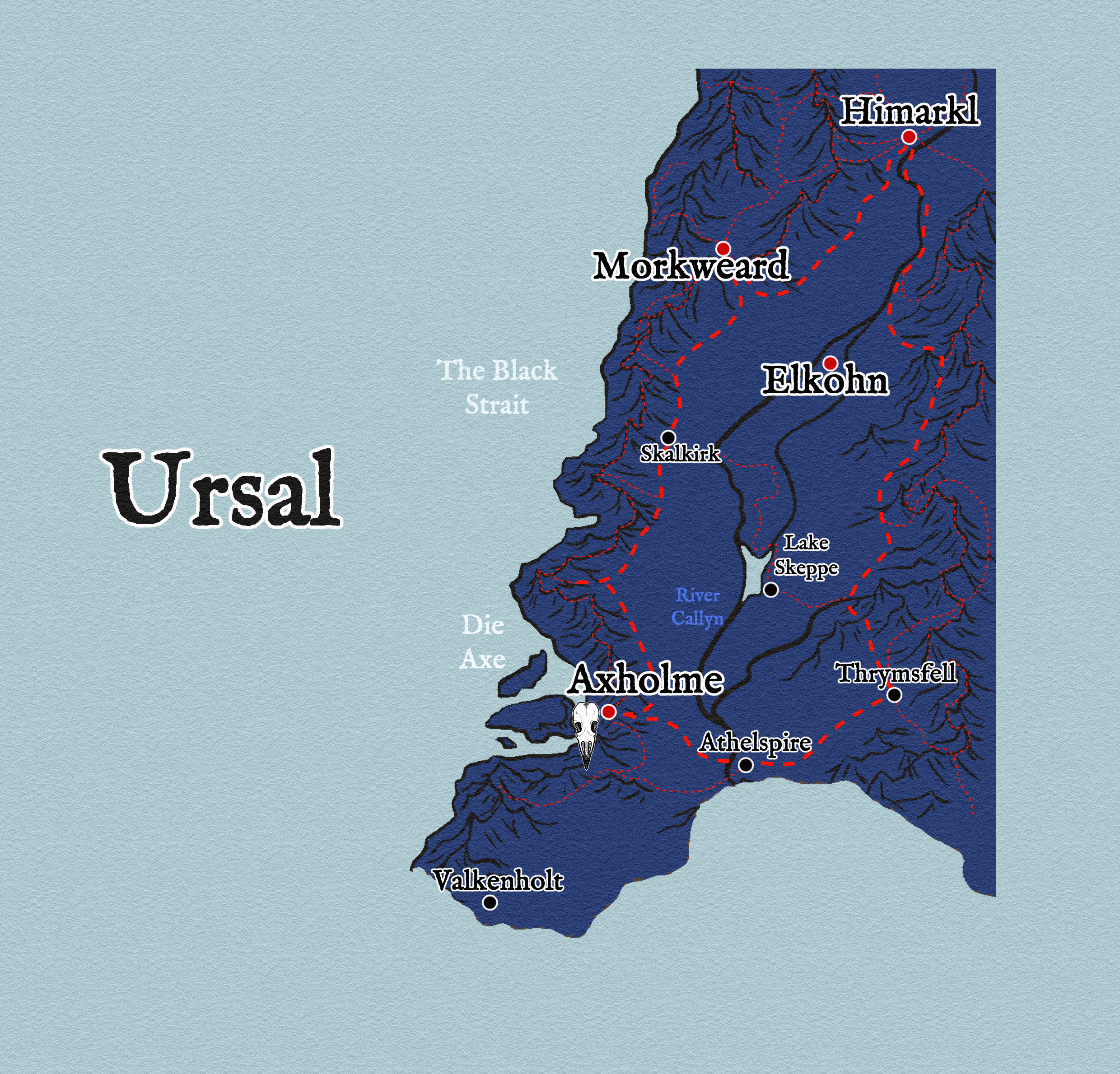
The primary route for the Pilgrim’s Path is shown on this map as the thicker line forming a circle, starting from Athelspire, up to Himarkl and back again. This is the most common route and considered the safest, used doubly as the main trading loop around the nation.
Secondary and tertiary routes form the thinner lines that branch out into the depths of the mountains, with a single route across Lake Skeppe. These routes become more treacherous as they delve deeper into the wilds - not for lack of care, but Ursal's wilds are known to be dangerous and unforgiving to the unprepared traveller.
Cairn stones can be found along the marked paths, leading pilgrims for centuries to the ancestral barrows.
At each site, it is customary to leave offerings to the dead. This ranges from humble leavings of bread and milk, or a small share of harvest, to more lavish offerings of gold, jewellery and bolts of fine cloth like silk or wool. It is deepest taboo to take any of these offerings, even the most wealthy, and it is believed that Helligfar will send his agents to hunt you if you steal from the sacred sites.