v2.0
Contents
- Full Rules PDF
- The Game
- A Live Site Game
- Co-operation is Critical
- Character Creation
- What Makes a Character
- Basic Training
- Backgrounds
- Progression
- Stacking Skills
- The Prospectus
- Skill Index
- Spells & Magic
- Game Mechanics
- Content Warnings
- Accessibility
- Call & Effect Glossary
- Appendix A: Change Log
- Appendix B: Bow and Crossbow Safety Rules
Full Rules PDF
Click here to download the PDF version of the v2.0 rules.
The Game
Jaeger is a live action roleplaying game inspired by gothic horror, folklore, the occult and the supernatural. It takes place on a fictional continent inspired by mainland Europe. You will take on the role of a Jaeger, a professional hunter of monsters, travelling across the continent to repel the forces of Evil.
The game takes place in a pseudo-18th century, 1751 at the game’s start. Technology is largely the same between our world and theirs, with some steampunk elements to accommodate a more advanced flavour of technology accessible only to Jaegers. A knowledge of the history of the era is not required to play. The real world reference points are simply that – references. The rest of the world and its history is fictional.
For this campaign, your character has newly completed their training at a Jaegerhaus and has been brought out to experience their first field missions, and have been accompanied by more experienced Jaegers, who are assessing them. As events have unfolded, you have received a field promotion and are now fully fledged Jaeger.
Jaegers follow a code that gives them the greatest chance of success and survival. It is short enough to be easy to remember, though some would say its briefness allows a good deal of flexibility in interpretation.
- Never go alone.
- We are not the law.
- Live to fight another day.
- Remember your enemy.
The Jaegerhauses are the schools where that training happens. The first was founded in 1580 in Dolchzahnfurt and remains the main base of operations for all Jaegers; there are six others across the continent, one in each nation except Gaulois.
Recruits must be at least 18 and undergo a minimum of three years of formal training – the first year of Basic Training bringing everyone up to a common standard, the following two dedicated to their three chosen Modules. In each nation, the Jaegerhauses are; Coaleigh in Bevany, Puente de Piedra in Calcera, Vadali in Tarquinia, Axholme in Ursal, and Dolchzahnfurt and Hartfelde in Verda.
Roleplay is emphasised over rules. Experimentation, and working with the skills you have, is the key to unlocking the secrets and mysteries of the game.
A Live Site Game
Jaeger events usually take place on a scout camp, activity centre, or similar outdoor location. We make sites like this “live” – an active environment that exists regardless of the players within it.
The site becomes the world for the duration of the event. Different buildings, clearings, and forested areas become different locations within the story. NPCs and monsters move through those spaces, and the plot unfolds around you. You’re not just watching events happen – you’re right in the middle of them.
Crucially, the world does not wait for you. Events will occur, situations will develop, and things will change whether or not your character is present to witness them.
Exploration isn’t just encouraged – it’s how you engage with the full breadth of what’s on offer.
The players who wander down an unfamiliar path, linger a little longer than usual, or follow a thread that isn’t obviously tied to their own goals are often the ones who find the most rewarding experiences.
Co-operation is Critical
Jaeger lives or dies on collaborative roleplay. This is a core principle that’s integral to how the game works.
There can sometimes be a feeling of competition at LARP, where your character might have a rivalry with another player’s character, factions might work against each other, and the Game Team might genuinely feel like the opposition you’re working to outwit. That tension can be thrilling – but in the end, Jaeger is a cooperative experience, and the goal is a great story for everyone in it.
The plots we design have flex; some things have multiple solutions, some threads have hard endings, but how you get there is rarely fixed. The same situation, approached by different groups of players, will produce different stories and results. Which alliances form, what sacrifices get made, and which lines characters refuse to cross are all things that matter to how the game unfolds.
Your job isn’t just to pursue your own character’s goals, it’s to give other players something to react to, and to be as interested in what the person across from you is experiencing as in what you’re experiencing yourself.
This matters especially in a horror setting; dread needs room to breathe. A scene that could be genuinely unsettling gets hollowed out if everyone’s rushing to get to the next hook.
Trust the atmosphere and your fellow players. Some of the best moments in Jaeger happen when people slow down and share the experience together.
If you find yourself struggling with a puzzle or any element of the plot, lean on your fellow Jaeger!
Character Creation
All characters are human and have studied at one of the continent’s Jaegerhauses. A Jaegerhaus is a formal institution of research and study.
Circumstances did not wait for your graduation from Recruit. You received a field promotion and are a Jaeger now, ready or not.
What Makes a Character
Building a character takes four steps.
| Step | What you do | What you get |
| 1 | Begin with Basic Training | 2HP and skills every Jaeger shares |
| 2 | Choose one Background | Learn the Apprentice skillset, reflecting your life before the Jaegerhaus |
| 3 | Choose three Modules from the Prospectus | Learn all Basic Skills from three Modules, reflecting your studies |
| 4 | Attend events | Earn 1 Credit each event, which is spent on progression |
Basic Training
When you join a Jaegerhaus you undergo a rigorous programme to bring you up to speed on the basics of arms, armour and education.
All characters begin with 2HP and all of the following skills:
| Ambidexterity | Buckler | Execute |
| Juryrig | Light Armour | Listen |
| Lucky Escape | RRR | Small Weapons |
| Thrown Weapons |
Backgrounds
Your Basic Training is supplemented by who you were before you became a Jaeger, and by what skills you brought to the Jaegerhaus with you.
Characters must select one Background and gain its Apprentice Skillset. Backgrounds allow characters easier access to their associated skills, where other characters would take much longer to learn them.
The Journeyman Skillset must be unlocked before the Master Skillset.
Some Backgrounds come with a level of roleplay that will give you game in some areas but lock you out of others. Please consider this carefully when creating a character.
Academic
Research and study are nothing new to you. You have opted for a transfer from one of the universities or schools across Aynca, and perhaps hold a hunger for the forbidden knowledge only held by the Jaegerhauses. After all, to be forewarned is to be forearmed.
This Background is perfect for those who like to be in the know, or who want to act as a face role. If you prefer low or no combat, this may suit you well.
| Skillset | Cost | Skills |
| Apprentice | Included at character generation | Deduction, Infernal Linguist, Puzzler, Cartographer |
| Journeyman | 2 Credits to unlock all skills | Resist Magic, Slow Bleeder, Meditation |
| Master | 2 Credits to unlock all skills | Detect Lies, Incantation, Interrogate |
Commoner
Your life was simple. You were a farmer, or perhaps a hunter, even a candlestick maker. Whatever you were doing before, something along the way meant that you found yourself wishing to be more than the lot you were bestowed at birth.
This Background is by no means the basic Background. It is the quintessential Jaeger Background, combining combat and specialist skills.
| Skillset | Cost | Skills |
| Apprentice | Included at character generation | Medium Weapon, Large Weapon, Vigour, Bait |
| Journeyman | 2 Credits to unlock all skills | Sturdy, Evaluate, Intuition |
| Master | 2 Credits to unlock all skills | Slow Bleeder, Vigour, Rifle |
Merchant
You are most at home at a forge, with a needle and thread in hand, or with any other means of creating vital items and equipment. Your talents meant that you found a quick home outfitting the Jaeger.
This Background is the backbone of a Jaeger team, with the ability to one day channel magic through their mastery of crafts. If you prefer low or no combat, this may suit you well.
| Skillset | Cost | Skills |
| Apprentice | Included at character generation | One Crafting I skill (Chemistry, Foundry or Gunpowder), the matching Crafting II skill, Evaluate, Intuition |
| Journeyman | 2 Credits to unlock all skills | A second Crafting I skill in a new craft, Slow Bleeder, Recognise Forgery |
| Master | 2 Credits to unlock all skills | The matching Crafting II skill to the Journeyman, Conduit, Forgery |
Minor Noble
Your family is just one of hundreds in the minor nobility of your homeland. Life was planned out for you from birth to death, and you decided that you wanted to take control of your own destiny.
This is a Background with potential for higher risk and conflict roleplay. Expect to use your wits and charm to make use of it, as not all have love for the aristocracy, and you may still have family duties to fulfil. You do not need this Background to roleplay as a Minor Noble – you can play a noble Soldier, Merchant and so on without it.
Titles you may take, in lowest to highest rank, are:
- Verdan Peerage: Ser, Baronet, Baron, Visconte
- Ursan Peerage: Carl, Reeve, Thegn
| Skillset | Cost | Skills |
| Apprentice | Included at character generation | Medium Weapon, Detect Lies, Pistol, Intuition |
| Journeyman | 2 Credits to unlock all skills | Duelling, Medium Armour, Favour |
| Master | 2 Credits to unlock all skills | Meditation, Rifle, Deception |
Physician
Practising in the Jaegers is a far cry from the hospitals and clinics of the cities and countryside. It is a medical marvel to witness what Evil can inflict upon people, only for you to heal and eradicate it. You took The Physician’s Oath when you became a doctor, and now you will take those skills beyond mortal reaches.
This Background is the staple healer, but with some spice. An excellent choice for those who prefer a backline role in conflict but a frontline role in research and study.
| Skillset | Cost | Skills |
| Apprentice | Included at character generation | Diagnosis, Staunch, Bandage, Surgery |
| Journeyman | 2 Credits to unlock all skills | Treatment, Intuition, Meditation |
| Master | 2 Credits to unlock all skills | Adrenaline, Mortician, Slow Bleeder |
Priest
You have spent most of your life preaching for The Fayth, Heltevei or Confluence. Your stalwart beliefs became a call to fight against the forces of Evil, pushing you into the dangerous life of a Jaeger. The danger is worthwhile, however, as this is your divine calling.
This Background is key for those who want to immerse themselves in the religion game. It is diametrically opposed to the Witch Background, but without the risk of being bound to Evil.
| Skillset | Cost | Skills |
| Apprentice | Included at character generation | Bless, Repel Undead, Sanctify, Ritualist |
| Journeyman | 2 Credits to unlock all skills | Consecrate, Exorcism, Meditation |
| Master | 2 Credits to unlock all skills | Curse Breaker, Divination, Banish |
Soldier
You served in one of the nation’s militaries, perhaps even old enough to have seen war in your time. In this extended period of political peace, your itch for battle made the Jaegers a perfect match.
This Background is designed for the frontline, for the paladins, for the tanks. Ideal for players dedicated to protecting others – and after all, a good defence is a good offence.
| Skillset | Cost | Skills |
| Apprentice | Included at character generation | Vigour, Medium Weapon, Large Weapon, Heavy Armour |
| Journeyman | 2 Credits to unlock all skills | Rifle, Sturdy, Strike Down |
| Master | 2 Credits to unlock all skills | Slow Bleeder, Vigour, Crush |
Witch
Once, you had given yourself over to Evil. By making a pact with a demon you learned the dark arts of magic and inflicted it upon others as a scourge. Something along the way made you realise the error of your ways, and somehow you managed to break your pact and retain your magic. How did you do it? Not many are willing to share.
This is a Background with high character risk and conflict heavy roleplay. Many will distrust you, some may hate you. Never will you touch the true light of Good or religion. Is the boon offered by your dark past worth it?
| Skillset | Cost | Skills |
| Apprentice | Included at character generation | Lesser Spellcraft, Commune with Spirits, Lesser Pacts, Ritualist |
| Journeyman | 2 Credits to unlock all skills | Greater Spellcraft, Meditation, Chemistry |
| Master | 2 Credits to unlock all skills | Greater Pacts, Divination, Curse Breaker |
Progression
After each event you gain 1 Credit. Credits are used to purchase new skills, and may only be spent on your Background Skillsets or on skills in the Prospectus.
Background Skillsets cost 2 Credits and unlock every skill in that set at once. The Journeyman set must be unlocked before the Master set.
In the Prospectus, you can either:
- Spend a Credit to learn one Advanced Skill in one of your three starting Modules, or
- Spend a Credit to learn one Basic Skill in a new Module.
- When a new Module’s Basic Skills have all been unlocked, you can then purchase its Advanced Skills.
Each individual skill learned this way costs 1 Credit. You may bank Credits and decide on how to spend them later.
Purchased skills are unlocked in all locations and do not need to be purchased again, unless they are a stackable skill.
Stacking Skills
Some Background skills also appear in the Prospectus. Only Stackable Skills may be taken more than once, and each purchase must be made individually.
The Stackable Skills are Crafting I, Crafting II, Meditation, Slow Bleeder and Vigour.
The Prospectus
The Jaegerhauses are schools where Jaegers come to hone their craft. New students go through a structured programme, and more experienced Jaegers return to brush up on their knowledge and learn of any new research developments. They are institutions of dark academia, and the general populace sometimes view them as peculiar and suspicious places.
Combat Training
This module focuses on the front line, on Jaegers who put themselves directly between the innocent and the forces of Evil. It allows you to hone your skills so that you can tackle your problems head on.
| Skillset | Cost | Skills |
| Basic | Included if chosen at character generation, otherwise 1 Credit each | Medium Armour, Medium Weapon, Vigour |
| Advanced | 1 Credit each, once all Basic Skills are unlocked | Heavy Armour, Large Weapon, Slow Bleeder, Strike Down, Sturdy, Crush, Duelling (Blades only) |
Devotee
This module teaches the fundamentals of utilising holy scripture and spiritual texts to defend and protect against the forces of Evil. Students are not members of the Clergy, and this is not a pathway to becoming part of it. It only provides the means to use a specific toolset.
Witches cannot learn Bless, Sanctify or Exorcism.
| Skillset | Cost | Skills |
| Basic | Included if chosen at character generation, otherwise 1 Credit each | Bless, Repel Undead, Meditation |
| Advanced | 1 Credit each, once all Basic Skills are unlocked | Sanctify, Exorcism, Intuition, Curse Breaker, Ritualist, Consecrate, Resist Magic |
Field Medicine
Whilst it is unlikely you will find the time to become a proper doctor, you can certainly learn the art of medicine as a well trained medic. Keeping your fellow Jaegers on their feet against Evil is critical to the operation.
| Skillset | Cost | Skills |
| Basic | Included if chosen at character generation, otherwise 1 Credit each | Bandage, Staunch, Surgery |
| Advanced | 1 Credit each, once all Basic Skills are unlocked | Diagnosis, Treatment, Meditation, Adrenaline, Mortician, Slow Bleeder, Intuition |
Marksman
This module teaches the importance of keeping your distance whilst dealing as much damage as possible. It also teaches the importance of finesse, and the art of duelling.
| Skillset | Cost | Skills |
| Basic | Included if chosen at character generation, otherwise 1 Credit each | Projectile Weapon, Slow Bleeder, Pistol |
| Advanced | 1 Credit each, once all Basic Skills are unlocked | Rifle, Vigour, Pinning Shot, Intuition, Snipe, Resist Magic, Duelling (Pistols only) |
Monster Hunter
Your goal is to be an effective killing machine against the creatures of Evil. It does not matter what they may be, you will be prepared to track them down and take them out.
| Skillset | Cost | Skills |
| Basic | Included if chosen at character generation, otherwise 1 Credit each | Bait, Tracking, Traps |
| Advanced | 1 Credit each, once all Basic Skills are unlocked | Tracking II, Traps II, Repel Undead, Heavy Armour, Resist Magic, Sturdy, Large Weapon |
Quartermaster
Anyone can pick up a new skill to create, and this module aims to allow you to do exactly that. In addition, learn the value of items and components, and how to spot a fake.
| Skillset | Cost | Skills |
| Basic | Included if chosen at character generation, otherwise 1 Credit each | Crafting I (Chemistry, Foundry or Gunpowder), Evaluate, Intuition |
| Advanced | 1 Credit each, once all Basic Skills are unlocked | Crafting II (Based on Basic pick), Recognise Forgery, Medium Armour, Meditation, Conduit, Resist Magic, Slow Bleeder |
Scholar
Scholars who are Jaegers are much more than your standard academic. They are shrewd tacticians who seek the truth, and are happy to tread the line between Good and Evil to better understand it.
Priests cannot learn Infernal Linguist or Incantation.
| Skillset | Cost | Skills |
| Basic | Included if chosen at character generation, otherwise 1 Credit each | Infernal Linguist, Meditation, Deduction |
| Advanced | 1 Credit each, once all Basic Skills are unlocked | Detect Lies, Puzzler, Incantation, Cartographer, Interrogate, Resist Magic, Intuition |
Scout
Rather than spend your time poring over books in the library, you prefer to see things with your own eyes. Your skill at remaining undetected has allowed you to study each category of monster through careful observation.
| Skillset | Cost | Skills |
| Basic | Included if chosen at character generation, otherwise 1 Credit each | Intuition, Stealth, Discern Creature I |
| Advanced | 1 Credit each, once all Basic Skills are unlocked | Discern Creature II, Assassinate, Assassinate II, Stealth II, Cartographer, Rifle, Slow Bleeder |
Skill Index
Notes on Skills
A skill unlocked in one place unlocks them everywhere. Stackable Skills are the exception. These may be bought more than once, and each purchase must be made individually.
The Stackable Skills are: Crafting I, Crafting II, Meditation, Slow Bleeder and Vigour.
Some skills may refer to a “Lammie” – this is a card attached to an item or person which gives specific information that your character could possibly know, or to give out of character information.
Skills may also refer to a “Phys Rep” – this is short for Physical Representation and normally means a prop or similar physical item, for example, a piece of armour, prop like a book or a LARP safe weapon.
Skill List
| Skill Name | Location | Description |
|---|---|---|
| Adrenaline | Physician, Field Medicine | You may administer a shot of adrenaline to a target on their Bleed Out. The target is temporarily restored to full health for 3 minutes, after which they automatically drop to their Bleed Out. |
| Ambidexterity | Basic Training | You may wield a one-handed weapon or pistol in either hand at the same time. |
| Assassinate | Scout | While in Stealth, and physically in line of sight of a creature you have used Discern Creature I on, you may call Fatal against it within 10ft. Doing so immediately breaks your Stealth. |
| Assassinate II | Scout | While in Stealth, and physically in line of sight of a creature you have used Discern Creature II on, you may call Irresistible Fatal against it within 10ft. Doing so immediately breaks your Stealth. |
| Bait | Commoner, Monster Hunter | You begin every event with four Lures. When setting a Lure, you must attach a lammie to an appropriate phys rep, and you must then take a referee to your Lure so that they know where it is. |
| Bandage | Physician, Field Medicine | You may spend 10 seconds bandaging a target’s most critical wounds to temporarily stabilise them at 1HP. A bandage phys rep is required. The target is considered Maimed, but alive. They must be healed by Treatment, a potion or magic to fully recover. |
| Banish | Priest | Three times a day, you may spend 10 seconds giving a religious speech to banish a Lesser Evil creature, calling Magic Fatal against it. |
| Bless | Priest, Devotee | Three times a day, you may Bless a target or a weapon. Cast on a weapon, the wielder may strike for Magic damage. Cast on a target, they may resist spell effects. The effect for both lasts for 10 minutes. Witches cannot learn this skill. |
| Buckler | Basic Training | You may use small shields of up to 18 inches (45cm) in size. |
| Cartographer | Academic, Scholar, Scout | You may create a map of an area by spending at least 30 minutes traversing it, or by seeing it from above. Once a day, your knowledge of maps and topography enables you to identify a resource location not already on a map. Notify a referee, who will inform you of the location of a resource on the map you are providing. The resource may not be immediately available, as it will need to be deployed. |
| Chemistry | Merchant, Quartermaster, Witch | Counts as a pick of Crafting I. Unlocks Chemistry recipes. |
| Chemistry II | Merchant, Quartermaster | Counts as a pick of Crafting II. Unlock Chemistry II recipes. |
| Commune with Spirits | Witch | You may spend 5 minutes, with the appropriate roleplay, attempting to endear yourself to the local spirits in exchange for information. The local spirits may ask for an appropriate payment. A referee is required for a response, and results may not be immediate. |
| Conduit | Merchant, Quartermaster | Unlock Conduit recipes. You understand how to safely handle Crystal without taking negative effects. |
| Consecrate | Priest | Once a day, you may Consecrate an area of a 10ft radius until the next morning. This will stop common supernatural beings from entering. A phys rep of white rope must be laid around the boundary. Priests may work together to Consecrate larger areas, extending the radius by 10ft for each Priest contributing. A Consecration can be refreshed if it has been tampered with, without another expenditure of the skill. |
| Crush | Soldier, Combat Training | Three times a day, with a Large Weapon, you may call Crush. Any armour targeted by the call is reduced to 0AP. If the target is not wearing armour, or their armour is already at 0AP, they are reduced to 0HP. An item targeted by the call is broken and will require magical or physical repairs. |
| Curse Breaker | Priest, Witch, Devotee | Three times a day, you may use your abilities to break a Lesser Curse laid upon yourself or someone else. More powerful Curses can be broken with more individuals working on the Curse together. However, Witches and Priests cannot do this together. |
| Deception | Minor Noble | Anyone can lie, but those with this skill can twist their words and obscure their meaning to those who would see through others’ deception, such as through Detect Lies, through years of practice. Three times a day, you may compose yourself in such a manner that you can convincingly deceive a target without being caught. |
| Deduction | Academic, Scholar | Once a day, you may present a theory of no more than 30 words to a referee, together with the evidence your character has gathered to support it. If your evidence supports the theory, the referee will tell you whether your line of investigation is on the right track – yes or no. If you cannot show your working, the referee will respond “insufficient evidence.” Either way, the skill is expended for the day. |
| Detect Lies | Academic, Minor Noble, Scholar | Three times a day, you may determine whether a target is lying to you. If a target is immune to this effect, or resists it, they are not required to inform you. |
| Diagnosis | Physician, Field Medicine | You may spend 5 minutes studying a human target to determine what is ailing them and, where appropriate, what the solution is or what other skills are required to treat the ailment. More individuals with the Diagnosis skill may work together to either reduce the time taken, or to determine trickier ailments. |
| Discern Creature I | Scout | You may study a creature for 5 minutes to determine what type of creature it is. Out of character, the creature will tell you the type. E.g. Undead, demon, etc. |
| Discern Creature II | Scout | After studying a creature, you may reveal further information about it. A referee will be required to provide this. |
| Divination | Priest, Witch | Once a year, you may spend 10 minutes in deep thought or in a personal ritual to try and glimpse a possible future. You are placed on your Bleed Out at the end of the ritual, and performing it will attract the attention of all supernatural beings in the area. |
| Duelling | Minor Noble, Combat Training, Marksman | You gain benefits in a duel. In a duel, this skill allows you to roll with advantage. See the Duelling rules in Game Mechanics. Taken through Combat Training, this skill applies to Blades only. Taken through Marksman, it applies to Pistols only. |
| Evaluate | Commoner, Merchant, Quartermaster | After examining a non-magical item for an appropriate time, you may determine its worth. This information will be on the attached lammie. If there is no lammie, the item is of little worth. |
| Execute | Starting skill | When a target is on their Bleed Out, you may deliver a slow, dramatic blow and make the call Execute to end their Bleed Out and kill them instantly. |
| Exorcism | Priest, Devotee | Three times a day, you may brandish a holy symbol and, after a 30 second speech attuned to your faith, attempt to Exorcise an Evil creature from its current host. Witches cannot learn this skill. |
| Favour | Minor Noble | Once an event, you may call in a favour from your extended network. Favour requests must be achievable and must be put in writing to be given to a referee. You must know where the target is, and there must be a feasible way for the request to reach them. Favours may have an appropriate cost. You should include whether you are willing to barter for that cost. Costs will be measured against your relationship to the target and the size of the favour requested. |
| Forgery | Merchant, Quartermaster | You may create convincing forgeries within your areas of crafting. |
| Foundry | Merchant, Quartermaster | Counts as a pick of Crafting I. Unlocks Foundry recipes. |
| Foundry II | Merchant, Quartermaster | Counts as a pick of Crafting II. Unlocks Foundry II recipes. |
| Greater Pacts | Witch | You gain the ability to make Greater Pacts. Your Lesser Spell slots increase by 2 and your Greater Spell slots increase by 2. See Spells & Magic. |
| Greater Spell craft | Witch | You gain the ability to cast 4 Greater Spells per day. See Spells & Magic. |
| Gunpowder | Merchant, Quartermaster | Counts as a pick of Crafting I. Unlocks Gunpowder recipes. |
| Gunpowder II | Merchant, Quartermaster | Counts as a pick of Crafting II. Unlocks Gunpowder II recipes. |
| Heavy Armour | Soldier, Combat Training, Monster Hunter | You may wear up to Heavy Armour, which consists of chainmail and plate armour, which grants 4 Armour Points (AP). Arrows and rifle shots go through this armour. |
| Incantation | Academic, Scholar | You have learned a small amount of magic. Choose three Lesser Spells. You may cast each of those spells three times a day without components. You may also assist in rituals led by Priests or Witches, but you may not lead them. Priests cannot learn this skill. |
| Infernal Linguist | Academic, Scholar | You have devoted yourself to better understanding the enemy by learning the language they use to communicate. You receive a piece of OC cipher for Infernal. Priests cannot learn this skill. |
| Interrogate | Academic, Scholar | Three times a day, you may use Command plus up to 10 words to question a non-allied target. This skill may not be used in combat and requires a 5 minute roleplayed conversation. |
| Intuition | Commoner, Merchant, Minor Noble, Physician, Devotee, Field Medicine, Quartermaster, Scholar, Scout, Marksman | Once a day, you may speak to a referee and pose them a question. The question may be no longer than 30 words. The referee will ask for your character’s Background, Modules and a brief summary of your character, as this will help determine the response. The response will also be no longer than 30 words, and your memory may not be entirely accurate or relevant. |
| Juryrig | Basic Training | You may roughly repair armour you are able to wear to 1AP. Your own armour must be removed if you are repairing it yourself. To be fully mended, armour must be fixed by a Foundry crafter. |
| Large Weapon | Commoner, Soldier, Combat Training, Monster Hunter | You may wield any large, cored weapon between 42”/105cm and 84”/210cm in length. |
| Lesser Pacts | Witch | You gain the ability to make Lesser Pacts. Your Lesser Spell slots increase by 1. See Spells & Magic. |
| Lesser Spellcraft | Witch | You gain the ability to cast 6 Lesser Spells per day. See Spells & Magic. |
| Light Armour | Basic Training | You may wear Light Armour, which consists of padded cloth and soft leather, and grants 2 Armour Points (AP). Arrows, pistol and rifle shots go through this armour. |
| Listen | Basic Training | All characters can Listen carefully to hear the movements of nearby people and monsters. To Listen, you must already be hidden and unobserved. You may then take 3 steps out of cover while showing a closed fist and look around, without moving further away from your initial position. If you can see any enemies, you are not observed. Monsters will not notice you while you are Listening, as you still count as hidden and in cover. Listening does not make you invisible – it represents you staying hidden while the mechanic makes you visible out of character. If a monster moves into a position where it could see you in your hidden position, Listening offers no protection unless you were using Stealth beforehand. You cannot Listen, move unobserved into a position, and then attack, because in the game your body would not have moved. If a fight breaks out where your body should be, you must return there immediately. |
| Lucky Escape | Basic Training | This is an accessibility feature and must not be used to gain a mechanical benefit. It exists to allow everyone to participate in high combat encounters which would otherwise be fatal because of out of character considerations. There is no limit to the number of times you may use it. If you find yourself in a situation your character could escape from, but you cannot due to mobility issues, processing speed or any other physical or cognitive issue, you may put your finger in the air and move out of danger without taking damage. You may either return immediately to Base Camp, or rejoin the encounter from a point clearly outside of danger after two minutes. This skill cannot be used to escape hopeless situations, such as being trapped in a room with no way out. It cannot be used to prevent damage that would definitely affect someone who could sprint quickly, such as being hit by suppressing fire at point blank range. If you are a non-combatant, please declare non-com to minimise the possibility of being struck. You may use Lucky Escape or follow the non-combatant rules depending on the scenario taking place. We recognise that low combat rules often force people to play on hard mode. This rule is specifically designed to make combat accessible and less unfairly deadly for those with accessibility considerations. We do not expect it to be used by people who are already playing on standard mode. We also recognise that not all disabilities are visible, and we will not ask for justification. If you think this skill is appropriate for you, we believe you. |
| Medium Armour | Minor Noble, Combat Training, Quartermaster | You may wear up to Medium Armour, which consists of hard leather and splint mail, and grants 3 Armour Points (AP). Arrows, pistol and rifle shots go through this armour. |
| Medium Weapon | Commoner, Minor Noble, Soldier, Combat Training | You may wield any cored weapon between 18”/45cm and 42”/105cm in length. |
| Meditation | Academic, Minor Noble, Physician, Priest, Witch, Devotee, Field Medicine, Quartermaster, Scholar | Once a day, you may spend 10 minutes stilling your mind, or in personal ritual, with appropriate roleplay to restore three uses of a Basic/Apprentice Skill you possess, two uses of a Journeyman/Master/Advanced Skill you possess. Meditation cannot be used to restore itself. |
| Mortician | Physician, Field Medicine | You may examine a target that has died. You can identify the cause of death and any other unusual effects upon them. You will receive more information the fresher the corpse is. You may also surgically alter a corpse with at least one minute of roleplay, to suitably cripple it so that it cannot be raised by any means. |
| Pinning Shot | Marksman | Three times a day, you may call Halt when shooting a target with a Projectile Weapon. The target takes damage as normal. |
| Pistol | Minor Noble, Marksman | You may wield single shot cap or popper pistols. Reloading should take at least 10 seconds. Pistol shots go through Light and Medium Armour. When targeting with a firearm, you must point and call out your target before shooting to alert them of the shot. Misfiring caps count as a failed shot and must be reloaded. |
| Projectile Weapon | Marksman | You may wield bows and crossbows up to a 30lb/13.6kg draw limit. These have an innate Through on hit, and the call is not required. |
| Puzzler | Academic, Scholar | Puzzles in the game are hard skilled, but you may obtain one clue to one puzzle per event to help solve it. |
| Recognise Forgery | Merchant, Quartermaster | After examining an item for an appropriate time, you may spot whether it is legitimate or fake. This information will be on the attached lammie. If there is no lammie, speak to a referee. |
| Repel Undead | Priest, Devotee, Monster Hunter | Three times a day, you may brandish a spell focus or holy symbol and, after a 30 second speech attuned to your faith, call Mass Fear Undead. You may choose to maintain your speech for 10 minutes, which allows you to call Mass Fear Undead at will so long as your speech is uninterrupted. |
| Resist Magic | Academic, Merchant, Marksman, Monster Hunter, Quartermaster, Scholar | Three times a day, when any spell is cast against you, you may call Resist to counter it. |
| Rifle | Minor Noble, Soldier, Marksman | You may wield cap or popper rifles and muskets. Reloading should take at least 10 seconds. Rifle shots go through all armour types. When targeting with a firearm, you must point and call out your target before shooting to alert them of the shot. Misfiring caps count as a failed shot and must be reloaded. |
| Ritualist | Priest, Witch, Devotee | You may lead and take part in rituals to harness spiritual or magical power to achieve a common goal. All rituals must be officiated by a Story Ref for that event. Priests and Witches cannot participate in rituals together. |
| RRR | Basic Training | Reading, wRiting and aRithmetic. You can read, write and calculate mathematics. |
| Sanctify | Priest, Devotee | Three times a day, you may brandish a holy symbol and, after a 30 second speech attuned to your faith, attempt to Sanctify an Evil item. Witches cannot learn this skill. |
| Slow Bleeder | Academic, Commoner, Merchant, Physician, Combat Training, Field Medicine, Marksman, Scout, Soldier, Quartermaster | You permanently add 1 minute to your Bleed Out. |
| Small Weapons | Basic Training | You may wield small weapons up to 18”/45cm in length. |
| Snipe | Marksman | With a Rifle, after 1 minute of careful aiming, you may call Fatal against your target. If you are distracted, you must start over. Calling for referee assistance does not count as a distraction, as it is an out of character action. When targeting with a firearm, you must point and call out your target before shooting to alert them of the shot. |
| Staunch | Physician, Field Medicine | You may staunch a wound by pressing bandages or cloth to the area. This pauses the target’s Bleed Out until they can be healed. Staunch may also be used by someone without the skill, so long as someone with the skill shows them how to Staunch while they both work on the same patient. They do not learn the skill permanently. |
| Stealth | Scout | Three times a day, you may raise a finger in the air to become hidden. You must keep your finger in the air throughout. While your finger is in the air, you may either: Hide against suitable cover, such as among trees or bushes, while remaining still, orMove at walking pace among suitable cover, such as trees or bushes. Each of these is one use of Stealth. You cannot combine them. Your Stealth ends when you drop your finger, or when you are subjected to the Detect call. When using Stealth at night, use a provided pink glow stick held up to denote your finger in the air. |
| Stealth II | Scout | Three times a day, you may raise a finger in the air to become hidden, exactly as Stealth. Additionally, you may call “Resist” to the “Detect Living” call once per each use of Stealth. |
| Strike Down | Soldier, Combat Training | Three times a day, with a melee weapon, you may call Strike Down. |
| Sturdy | Commoner, Soldier, Combat Training, Monster Hunter | Three times a day, you may resist the Strike Down call. |
| Surgery | Physician, Field Medicine | Every 15 seconds, you may heal 1HP to a target using an appropriate phys rep, such as surgery tools. While under the effect of Surgery, the target’s Bleed Out is halted unless you are interrupted. If interrupted, you must start over. Surgery is painful for a conscious target, and this should be roleplayed appropriately. |
| Thrown Weapons | Basic Training | You may throw coreless weapons of up to 18”/45cm in length. Thrown weapons must be larger than an eye socket. |
| Tracking | Monster Hunter | After studying an area for 1 minute, you may identify the type of creature that moved through the area. If you wish to track in an area with no tracking boxes, please find a referee and inform them that you wish to track, as it may require a different referee. |
| Tracking II | Monster Hunter | You may follow tracks for 5 minutes before losing the trail. You may also erase or alter tracks in an area, and you can tell if tracks in an area have been tampered with. You may remove tracking entries from Tracking Boxes and replace them with the provided slip reading “Tracks in this area have been wiped”. |
| Traps | Monster Hunter | You can detect traps, and you can make a trap, which must be phys repped appropriately. A 3ft area around the trap must be marked by the provided orange rope. Any creature who steps into that boundary is held in place for 1 minute. |
| Traps II | Monster Hunter | You can disarm traps, and you can make a better trap, which must be phys repped appropriately. A 3ft area around the trap must be marked by the provided blue rope. Any creature who steps into that boundary is held in place for 5 minutes. |
| Treatment | Physician, Field Medicine | Maimed and wounded targets can be treated in order to recover to full health, following 5 minutes of roleplay. |
| Vigour | Commoner, Soldier, Combat Training, Marksman | You gain +1HP. Each rank of Vigour also grants an additional 1d6 to your dice pool in a Brawl duel. |
Spells & Magic
Magic
Magic is the energy of the universe. Anyone with the right attunement can draw upon it, but what they draw it into depends entirely on what they have attuned themselves to.
Priests channel it through their faith, and it becomes Good. Witches channel it through their patron demon, and it becomes Evil. The Fae channel it through their inherent connection with the earth, and it becomes Nature.
This is not the traditional slinging of fireballs. Magic is bound in nature, in one’s soul and in the infernal, and it can only be tapped by those who have given themselves over to the forces that dictate the universe.
Witches
When a human comes face to face with Evil and makes a pact with it, they become a Witch. Witches can read the stars like a book, nurture a dying plant back to life with a single touch, and ensnare a soul to their will with an incantation. They are servants to an ever hungering ego that fuels their power.
What happens, though, when you face Evil and decide you no longer wish to be its indentured servant? There are those who have managed to deceive and manipulate their way out of their deals whilst retaining their power. How? You will have to find a Witch willing to tell.
The key pillars of witchcraft are Water, Earth, Air, Fire and Spirit. These are the fundamental elements that exist across both our plane and the Evil plane of existence, and are represented by the Compass (depicted below).
Crystal
Crystals are a rare byproduct of the presence of Evil. They are magic in its truest, rawest form, and only Witches and those with the Conduit skill are able to handle them in this state. It is exceptionally dangerous for anyone else, as Crystal can destroy the holder with its elemental alignment in an instant.
Crystal is nonetheless a vital tool for Jaegers in their hunts. It forms where Evil has touched, and the more powerful the Evil, the more Crystal. This allows Jaegers to determine the level of threat they may be facing.
Crystals are the elements in raw form, grown from Evil entering our plane. They are the most powerful source of magic available to a Witch to enhance their spells, which makes them a critical component of higher forms of magic.
| Crystal | Element |
| Blue | Water |
| Green | Earth |
| Red | Fire |
| White | Air |
| Purple | Spirit |
Spellcasting & Spell Focuses
There are common spells that all Witches know, so much so that they require no components other than spell slots to cast. Each spell costs a single spell slot aligned to Lesser or Greater spellcasting. A countered spell is still considered expended.
In place of components for basic spells, Witches use a Spell Focus: an extremely personal magical item that channels their energy into magic for as long as it is kept on their person. Spell Focuses are deeply personal, and to touch one without permission guarantees a nasty surprise. They are often gifted by the demon a Witch pacted with to gain their powers.
Spellfocuses must be lammied. You will receive a lammie for your Spellfocus when you come to your first event as a Witch. You must notify a ref if you ever lose your Spellfocus.
When a Witch has run out of spell slots, they can use their own life force as a source to cast more. The toll on their soul leaves scars, and a Witch who damages their soul too far risks it being rendered asunder and becoming an abomination of Evil. Every Witch knows this, and every Witch toes the line of caution. In game, this functions as a permanent reduction to your Bleed Out at a referee’s discretion.
Spell Verbals
Your spell verbal must always include a description of the effect on the target, a damage call (or both), and the spell name itself.
For example, when casting the spell Entangle, you could say, “I call upon the vines to spring forth and Entangle your feet, Mass Halt!” The call describes the effect, names the spell, and gives the call.
Where a call is not required, you must ensure to be clear in your phrasing. For example, when casting a spell like Cure Lesser Wounds, you could say, “I call upon my demonic patron to give me the power to stitch flesh and make you new – Cure Lesser Wounds!”
A target must be able to hear your spell vocal clearly for it to have any effect on them.
Ranges
Spells use standard ranges: Self, Other (1ft) and Ranged (30ft).
Spell List
Lesser Spellcraft grants 6 Lesser Spell Slots.
Greater Spellcraft grants 4 Greater Spell Slots.
One spell cast expends one slot of the matching level.
Lesser Spells
| Spell | Casting Time | Duration | Range | Effect |
|---|---|---|---|---|
| Charm | 10 seconds | 1 minute | Ranged | Call Charm. The target immediately trusts you and will act in a friendly manner toward you for the duration. They will not harm themselves, nor cause harm directly to others as a result. The target is aware of being Charmed and remembers their actions. |
| Countermagic | 10 seconds | Instant | Self, Ranged | A Lesser spell is countered and has no effect. |
| Cure Lesser Ailments | 30 seconds | Instant | Other | Cure a lesser status effect, disease, poison or other mundane ailment. |
| Cure Lesser Wounds | 30 seconds | Instant | Other | Heal 2HP. Cannot exceed the target’s maximum health. |
| Detect Magic | 10 seconds | Instant | Other | Call Detect Magic. Items or creatures of a magical nature within 1ft must respond with a clear, audible PING, or will be made known to you by referee, creature or lammie. |
| Eye of the Eagle | 30 seconds | 2 minutes | Self | You are given a vision of events occurring elsewhere by a referee. There is not always something to be seen, and the vision may not occur instantly. |
| Fumble | 10 seconds | 10 seconds | Ranged | Call Fumble, naming an item the target is holding. They must drop it for the duration. |
| Light | 10 seconds | As long as required | Self, Other | Using an appropriate phys rep, create a magical source of light. |
| Magical Armour | 10 seconds | Until used, or the next sunrise | Other | A target’s armour is imbued with magic to make it temporarily stronger. Grants 2 Armour Points (AP), which cannot be repaired. |
| Magical Weapon | 10 seconds | 5 minutes | Other | The target’s weapon temporarily becomes magical in nature. The wielder calls Magic when striking with it. While magical, the weapon cannot be Shattered. |
| Mend | 10 seconds | Instant | Other | Repair a Shattered item. |
| Remove Sense | 10 seconds | Permanent | Ranged | Call Remove Sense, naming the sense removed — Sight, Smell, Hearing, Taste or Touch. The target loses that sense and must roleplay accordingly. May be removed from a target with Cure Lesser Ailment. |
Greater Spells
| Spell | Casting Time | Duration | Range | Effect |
|---|---|---|---|---|
| Cerebral Scrying | 10 seconds | 1 minute | Other | Peer into the mind of a target to see what they remember of an event. A referee is required. |
| Command | 10 seconds | Instant, otherwise 1 minute | Ranged | Call Command followed by an instruction of up to 3 words. The target is compelled to follow it. Targets cannot be commanded to harm themselves. |
| Cure Greater Ailment | 30 seconds | Instant | Other | Cure a single greater ailment, or all lesser ailments on a target. |
| Cure Greater Wounds | 30 seconds | Instant | Other | Heal 4HP. Cannot exceed the target’s maximum health. |
| Detect Living | 10 seconds | Instant | Self | Call Mass Detect Living. Anyone within 10ft who is living must respond with a clear, audible PING. |
| Detect Unliving | 10 seconds | Instant | Self | Call Mass Detect Unliving. Anyone within 10ft who is undead must respond with a clear, audible PING. |
| Dispel | 10 seconds | Instant | Ranged | A spell up to Greater is dispelled and has no effect. |
| Enthral | 10 seconds | 10 minutes | Ranged | Call Command followed by an uninterrupted instruction of up to 10 words. The effect is instant, and lasts up to 10 minutes. Targets cannot be commanded to harm themselves. |
| Fearsome Presence | 10 seconds | 10 seconds | Ranged | Call Mass Fear. All targets within 10ft are stricken with Fear, specifically of you. |
| Entangle | 10 seconds | 10 seconds | Ranged | Call Mass Halt. All targets within 10ft are stopped in their tracks and cannot move for the duration. |
| Sow False Seeds | 10 seconds | Until the next sunrise | Other | Implant or change a single memory of a target. The target does not realise anything is amiss during the duration, and if the change is minor enough, they may not realise even once it has worn off. A referee is required. |
| Wither | 10 seconds | Until Dispelled | Ranged | Call Wither, indicating a limb. The limb is permanently destroyed and withered and must be roleplayed as unusable until removed by Dispel. |
Pacts
Pacts are complex forms of magic that require more time and work than just spell slots. Requirements are listed as below to cast a pact. Witches are welcome and encouraged to add their own flair and style to their Pacts.
Charms and items made from Pacts must be lammied, go to GOD to get one.
Lesser Pacts
These pacts allow individuals to form a magical bond with a Witch. In exchange for a benefit, the Pactee must bind themselves to the Witch.
Only one Lesser Pact can be active at any time. If a second Lesser Pact is cast, the first breaks without consequence.
Lesser Pacts increase your Lesser Spell Slots by 1.
| Pact | Casting Time | Duration | Effect |
|---|---|---|---|
| Pact of Fellowship | Ritual required | Until the next sunrise | Two Witches share their pool of magic with each other, tracked however the players see fit. Witches can only cast spells up to their own level of spellcrafting. |
| Pact of Lesser Enthrallment | 5 minutes | Until the next sunrise | The target is pacted to serve the Witch for the duration, or until they Bleed Out. Until next sunrise, or until they Bleed Out, whichever comes first, which releases them from it. The target gains +3HP. |
| Pact of the Unseen | 5 minutes | Until the next sunrise | The Witch crafts a magical charm granting mystic invisibility. The target becomes immune to the “Detect” call, so long as the target keeps the charm and the Pact is active. If the target loses the charm or has it taken, they are put onto their Bleed Out. The charm can only be disposed of safely by returning it to the Witch. |
Greater Pacts
A Greater Pact is formed between a Witch and a target, and gives the target a serious boon in exchange for a serious detriment.
A Witch can only enter one Greater Pact at a time, due to their power and the time they take to cast.
Greater Pacts do not affect active Lesser Pacts.
Casting a new Greater Pact breaks the previous one without consequence.
If the target of a Greater Pact kills their Witch, they are reduced to 0HP and will receive a Curse if they survive.
Greater Pacts increase your Lesser Spell Slots by 2 and your Greater Spell Slots by 2.
| Pact | Casting Time | Duration | Effect |
|---|---|---|---|
| Pact of the Coven | Ritual required | Until the next sunrise | As Pact of Fellowship, but a group of Witches share their pool of magic. Usually used as a short term, drastic measure to unify against a powerful foe. Witches can only cast spells up to their own level of spellcrafting. Continued use places all participating Witches in danger of exposure to too great a quantity of magic. |
| Pact of Enthrallment | 10 minutes | 1 event | A supercharged version of the Lesser Pact. The target is pacted to serve the Witch until they die. Going against the Pact puts the target on their Bleed Out, which releases them from it. The target gains +5HP, and gains the ability to wield any weapon and wear any armour. Some may even be granted limited use of a Lesser Spell. |
| Pact of Shared Souls | 10 minutes | 1 event | The target’s HP is reduced to 1. For as long as the Witch is alive, if the target is reduced to 0HP they drop for the duration of what would be their Bleed Out, then restore to 1HP. If the Witch dies, the target dies. If the target is put on their Bleed Out, the Witch is not. Execute does not work on the target when on their Bleed Out and the target may call Resist. |
| Pact of Spirit Charm | 10 minutes | 1 event | A Pact where the Witch is the target. After endearing themselves to a spirit, it may agree to become bonded to the Witch. It becomes a vigilant watcher, and if asked can give the Witch the Detect call three times a day. Other effects may apply depending on the type of spirit bonded. |
Curses
Standard Curses
The most common way to receive a curse is by meddling with Evil without proper preparation – for example, playing with a magical object of mysterious origin, or entering a warded area without checking it for magical traps first.
They vary wildly in severity, and so no curses are listed here. If you are cursed, you will receive an OC Curse Card in game detailing the nature of your curse and how to be rid of it.
Standard Curses are intended to be temporary and of varying difficulty to remove, but not impossible. All Standard Curses expire at the end of an event unless specified otherwise.
Standard Curses can be broken by fulfilling their terms, or by someone with the Curse Breaker skill.
Player characters cannot cast Standard Curses.
Witch’s Curses
All Witches have the innate ability to cast Curses, which puts those who have become Jaeger in a precarious place. Curses pull directly on the threads of Evil, and their results are powerful, permanent and life changing.
A pacted Witch has a patron to shoulder the weight of that power. You do not. Every Curse you cast is drawn through your own soul instead, and getting one wrong could be dire for you and for everyone around you.
Jaegers know this, which is why many are not certain that a Witch who still feels the need to Curse has truly separated themselves from Evil.
Curses are too personal to standardise, so no requirements are listed. You must determine your own.
If you wish to Curse a player character, you must seek Game Team approval first so they can check with the player for any triggers and ensure it would not ruin their game.
A Witch who tries to Curse a non-consenting player character will always fail, and will suffer an in character consequence imposed on them.
Game Team must be notified once a Witch’s Curse has been agreed in order to record it and referee the roleplay.
All Witch’s Curses are permanent.
| Witch’s Curse Examples | Effect |
|---|---|
| Curse of Lycanthropy | The target is cursed to become a lycanthrope of the Witch’s choice. The terms are dictated by the Witch — whether the curse manifests only on a full moon or permanently, and how it can be broken. The target is unaware of these terms in character, but will carry an OC Curse Card with the details. |
| Curse of Monstrous Form | The target is cursed with an unsightly, monstrous form. Players must determine out of character how this manifests, as it will need to be phys repped. Depending on the form, Game Team may determine that it comes with benefits, flaws or both. The Witch decides how the curse is broken. |
| Curse of Endless Sleep | The target is put into a deep sleep that mimics the effects of death. They are alive, but in a form of stasis, and can be kept that way for as long as the curse is in effect. The Witch determines how it is broken. Explicit permission must be given by the target if they are a player, and both players must notify Game Team, as this effectively kills the character. |
| Curse of Certain Death | The target is told when and how they will die. No matter what they try, the curse will always ensure it happens. The Witch determines how it is broken. The target may elect not to know the details of their fate, in which case the Witch can submit the curse effects directly to Game Team for enacting. |
| Curse of Undeath | The target’s corporeal form becomes the spiritual property of the Witch. When the target dies, their corpse rises once more for the Witch to use as they see fit. A more complex form of the curse leaves the target’s soul bound within the corpse, so that they rise with their memory and skills intact. What the Witch wants to achieve determines how difficult it is to cast. |
| Curse of Transfiguration | The target is turned into an animal such as a frog or a swan. They retain their human mind but cannot speak, and can only make the sound of the animal they have become. The Witch determines how the curse is broken, though traditionally True Love’s Kiss is the preferred method. |
Crafting
This section is still under review!
The mechanic of crafting is unlikely to change, but the recipes and quantity of them are likely to.
Game Mechanics
Safety Calls
There are two crucial safety calls all members of Jaeger — be they crew, Game Team or player — should be aware of:
Man Down
At an event, accidents can happen. If someone is injured and needs first aid, anyone on site can call “Man Down” loudly and clearly.
A referee will radio for a first aider, if one isn’t immediately available.
If you hear it:
- Drop to one knee immediately- this clears the sightlines for a first aider.
- Turn away from the incident to give the person privacy. You may move away when the first aider has arrived at the incident.
- Stay calm, stay nearby. The game is paused, but don’t wander off, you may miss key information.
- Wait for a referee to indicate next steps.
The “Okay” System
When roleplay becomes intense, emotionally heightened in any direction, players and crew can use the Okay hand signal.
This hand symbol is made by taking yourthumb and forefinger forming an O, held against the chest, to check in on how everyone’s doing.
By using this gesture, you are asking a player/crew/staff whether they are okay out of character. Their response will help you determine the best course of action.
Some folks are exceptional role players so you really can’t always tell, so it’s always good to check!
Breaking immersion to use this signal is always fine. Your out of character welfare matters more than the game.
| Thumbs Up Everything is good, please continue! | Wavering Hand I’m alright, but let’s bring it down a notch. | Thumbs Down I need this to stop. Walk away, take a few minutes, return when ready. No response = treat as thumbs down. End the roleplay immediately. |
Identifying a Referee
Jaeger is run by a Game Team of writers, designers, and organisers who build the world, write the plots, and manage the event.
You’ll recognise them at events by:
- Black tabards with the glow-in-the-dark raven skull logo, when refereeing
- Day-glow hi-vis vests or jackets, when safety marshalling*
*Not everyone marshalling is necessarily Game Team, but they can direct you to the right place.
The Game Team are unpaid volunteers who choose to spend their free time and holidays running Jaeger because they genuinely love the world they’re building and the community growing around it.
They are not your opponents, even if it might feel that way in game at times. Their job is to create the conditions for great stories, respond to what players do, and make sure the event runs safely and smoothly for everyone.
If you have a question, a concern, or if something’s gone wrong – they’re your first point of contact.
Embedded Non-Player Characters (NPCs)
Sometimes, members of the team will be in the game playing embedded NPCs. Their role is to facilitate the game in character, and they’ll usually be dressed like other players. Sometimes they may be wearing a radio with an earpiece, but not always.
These NPCs are not referees, but they can provide you in-character guidance and locate a referee if you can’t find one.
They can also signpost to other areas such as first aiders, manage safety in the area, and can radio in requests from GOD for further info if required, such as rules clarifications.
Your Role
In Jaeger you play a Jaeger, and you will encounter a variety of experiences both in and out of the game. The skills you choose for your character will help resolve problems and matters of plot.
You can play only one character at a time. If your character dies, or you choose to play a new character, your old one is considered dead or retired and cannot be played again unless under special circumstances determined by Game Team.
Some mechanics cannot be engaged with by a single character alone. Collaborating with other Jaegers is the key to success in this game.
Health, Hits & Dying
This game uses Global Hit Points.
This means that you have a pool of Hit Points for your whole body, and every wound comes out of it no matter where you are struck, whether it’s a blow to the arm or a blow to the leg, it will cost you the same.
However, we do use locational effects. For example, Wither and Fumble each do specific things to a specified part of you.
Please be aware that the head is not a valid target. Do not strike at this area. Effects may still apply to the head, but weapon blows must not.
Jaeger encourages players and crew to adopt a cinematic fighting style. This means that you will take no more than one damage per second from a single source. We hope this enables everyone to come up with creative and safe fighting styles that look amazing.
If you are reduced to 0HP you will begin to Bleed Out. Bleeding Out is when your character has taken too much damage, falls unconscious and starts to die. The Bleed Out period is 3 minutes.
If you are not healed by the end of those 3 minutes your character will die, and you must make a new character.
At any point that you lose HP, they can be restored by various means in game. There are also skills and abilities that improve your HP and prolong your Bleed Out.
Armour
Armour provides temporary HP in the form of Armour Points (AP). When struck, armour loses 1AP per hit until it is reduced to 0AP, at which point it breaks, provides no further protection and must be mended.
The exception is Through. This effect bypasses armour entirely and strikes directly at your HP.
Broken armour can be roughly repaired to 1AP with the Juryrig skill. To be fully mended it must be repaired by a Foundry crafter.
Armour Coverage
You have six armour locations: torso, left arm, right arm, left leg and right leg. The head does counts as an armoured location, even though it is never a valid target for striking.
At least three of those locations must be armoured for you to count as armoured. Below three, you have no armour, no matter what you are wearing.
There is no minimum coverage within a location, so long as what you wear can be visibly read as armour. A single vambrace gives the same coverage as a vambrace, gauntlet and pauldron worn together, but a leather cuff on your wrist is not readable armour and will not count.
However, a heavy trench coat counts as Light Armour, as it generally covers all locations.
Your armour type is whichever type covers at least three locations. Count locations, not pieces. Armour does not stack, so layering padding beneath splint mail does not make Heavy, and piling extra pieces onto one location does not raise your type.
- Splint mail on both arms and both legs is four Medium locations, providing Medium Armour coverage.
- Swap one arm for a metal pauldron and you have three Medium and one Heavy. Heavy covers only one location, so you remain at Medium.
- Two metal pauldrons and a metal helmet is three Heavy locations, so Heavy Armour – even though the legs are still splint mail.
One exception: Chain or plate chest armour always grants Heavy Armour, regardless of what else you wear.
Armour Specifications
| Armour | Phys Rep | AP | Notes |
| Light | Padded cloth and soft leather | 2 | Arrows, pistol shots and rifle shots go through this armour. Heavy trench coats count as full Light Armour |
| Medium | Hard leather and splint mail | 3 | Arrows, pistol shots and rifle shots go through this armour. |
| Heavy | Chainmail and plate armour | 4 | Arrows and rifle shots go through this armour. A chain or plate chest piece counts as full Heavy Armour. |
Jaeger exploits the fantasy gothic look, with the 17th and 18th centuries as a reference point. In our inspirational sources, armour is worn underneath clothing or as accent pieces rather than as full coverage, and that is the look we want to achieve.
You are welcome to wear any type of armour you please, so long as it fits the setting. A full plate chest piece with a highwayman style trench coat achieves a strong Jaeger look – but a full suit of plate armour is not appropriate, and neither are overly elaborate fantasy weapons and armour.
We welcome alternative materials for armour construction, but we expect those alternatives to be high quality. For example, a pauldron cut and carved from foam should be properly finished to look like steel as far as possible, and last for an entire event without coming apart.
Weapon Specifications
All weapons are checked on a case by case basis, and any weapon can be failed by a weapons checker at any point during an event. If your weapon fails, it will be tagged with a red cable tie and you must either leave it at GOD and collect it at the end of an event, or secure it away in your bunk/tent to keep it out of the game.
| Weapon | Specification |
| Small Weapons | A cored weapon up to 18”/45cm in length. |
| Medium Weapons | A cored weapon between 18”/45cm and 42”/105cm in length. |
| Large Weapons | A large cored weapon between 42”/105cm and 84”/210cm in length. |
| Thrown Weapons | A non-cored weapon of up to 18”/45cm in length. The impact surface must be larger than an eye socket. |
| Buckler | A small round shield up to 18”/45cm in diameter. |
| Bows & Crossbows | Maximum draw of 30lbs/13.6kg. |
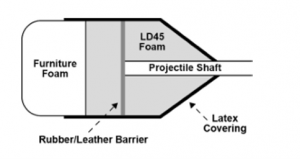
| Arrows & Bolts | The impact surface must be larger than the average eye socket. Screw-head arrows are never permitted. Arrows and bolts must be checked by their shooter with every shot, not only by a referee at weapons check. |
| Pistols & Rifles | Flintlock style cap guns, in pistol or rifle form. You must provide your own caps. Foam firearms using party poppers as ammunition are also welcome, but must never be used as a striking weapon. |
Stab-Safe Weapons
Stab-safe weapons are welcome in this system, but may only be used to stab once they have passed weapon’s check. They must be denoted with a white ribbon attached by that checker. Do not slash with a stab weapon.
If you lose your ribbon, take the weapon back to a checker for it to be rechecked to receive a new one.
Bows and Crossbows
Please refer to Appendix B at the end of this book for the full Bow and Crossbow rules.
Firearms Safety
Cap guns are not toys. Each cap is a small explosive charge, and at close range that means hot gas, burning fragments and a noise loud enough to cause permanent hearing damage.
A shot fired beside someone’s ear can deafen them for life. This is not a theoretical risk, and it does not require anything to go wrong.
Never fire past, over or across another person. If someone is between you and your target, you do not shoot – break off, move, or let it go. Firing over a comrade’s shoulder is the single most common way this goes wrong.
Keep the muzzle away from faces, including your own. Never look into the barrel and never fire with your face over the mechanism.
Anyone seen firing near another person’s face will be timed out immediately – even if accidental. If it happens again, you lose the use of firearms for the remainder of the event. Continued disregard means you will not be permitted to use firearms at Jaeger at all. If you cannot demonstrate that you can use them safely, you do not get to use them.
Carrying
Anyone may carry a body at a slow pace, using two free hands and with the consent of the player being carried.
Walking pace requires two players, each with two free hands.
Running with a carried body is impossible.
Do not touch another player unless explicit consent has been granted, and do not drag or pull them.
Duelling
Duelling is used to settle a dispute, generally only to first blood. Sometimes it can be set as a duel to the death — it depends entirely on the two individuals entering the duel and why they are duelling in the first place.
This is an out of character mechanic that determines in character roleplay and result. Dice are rolled, the higher result wins, and the players then discuss out of character how to play the duel out.
Duels come in three varieties: Pistols, Blades and Brawl.
Pistol Duelling
- Both duellists must have the Pistol skill.
- Each duellist rolls one d6. A duellist with the Duelling skill rolls with advantage, rolling one d6 twice and keeping the higher result.
- The duellist with the highest result wins. For a tie, both duellists miss their shots, or hit each other at the same time.
- Both duellists work out how they would like to roleplay the result, and then roleplay it.
- If the winner misfires, the loser wins instead, provided they can fire their shot. If both misfire, both lose.
Blade Duelling
- Both duellists must have the Medium Weapon skill.
- Each duellist rolls one d6. A duellist with the Duelling skill rolls with advantage, rolling one d6 twice and keeping the higher result.
- The duellist with the highest result wins. On a tie, the conditions of the duel are met by both duellists at the same time.
- Both duellists work out how they would like to roleplay the result, and then roleplay it.
Brawl Duelling
- Each duellist starts with 1d6, and gains an additional 1d6 for each rank of Vigour they have. This forms their dice pool.
- Both duellists roll their entire pool. The highest total wins.
- Both duellists work out how they would like to roleplay the result, and then roleplay it.
A referee must be present for a Brawl duel. It must be non-contact, and must take place in a safe area. Brawl duels may never be hard skilled.
Pistol and blade duels may be hard skilled.
A referee is not required for a pistol or blade duel, but Game Team should be informed if any duel has taken place.
Rituals
Witches and Priests can lead and participate in rituals. Those with the Incantation skill can participate but cannot lead. Witches and Priests cannot conduct rituals together, and attempting to do so will result in certain death.
All rituals must be officiated by a Story Ref for that event.
Where there is no skill or spell that quite fits a spiritual or magical need, a ritual may be used to formulate a suitable solution instead.
There is no minimum number of participants — a single person can conduct a ritual. However, you should scale the power of the participants to the effect desired. Balancing relevant skills, spellcrafting and items will help achieve a successful ritual. Overcharging a ritual with too much power is only possible in extreme circumstances.
Technique Development
Individuals can develop personalised techniques to improve and distinguish their specialities.
Only one technique can be developed at a time. On completion you get exclusive use of that technique, unless you wish to teach it to others. You cannot develop a technique and use an Inventor Slot at the same time.
Spells cannot be created using a technique, but other magical skill techniques can be – Commune with Spirits, for example.
You might improve Surgery so that it heals 2HP per 15 seconds rather than 1HP, improve Stealth so that you can move faster in cover, or become a master investigator by increasing Deduction’s theory limit from 30 words to 60.
To develop a technique, complete a Technique Development form and submit at GOD. You must clearly state what you are trying to achieve, and how you are going to achieve it.
Referees and Game Team will assess the difficulty of the technique, then determine the length of time and effort it should take to achieve. You will need to check in at GOD at each event so your progress can be tracked.
Creative roleplay and components can absolutely speed up progress, so think outside the box. You are welcome to involve others in your development, but the progress and study lies with the individual who submitted it.
Failure will be more common than success at the start, but the reward of an exclusive skill at the end should pay off the journey.
Tracking Boxes
Areas of the game should be searched for Tracking Boxes. These are small rectangle shaped wooden boxes with a slide top containing information about that area relevant to certain skills. This information will give you more information about the area, without requiring a referee.
Some tracking boxes are scroll tubes with cork tops, these will be harder to locate without careful investigation.
Some skills can change the contents of a Tracking Box. See Tracking II in the Skill Index.
Theft
You may only steal an in character item that has a lammie on it.
Theft must be reported to GOD within 30 minutes of the act, and you must bring a matching phys rep to replace the lammied item with.
Stealing from a fellow Jaeger is extremely frowned upon and may result in official consequences within the game. However, there may be times where stealing from foes is required to carry out a mission. Be aware as if you are caught, there will be consequences.
Content Warnings
This is an 18+ game, designed as a horror experience. It may include sudden loud noises, flashing lights, and themes of fear or psychological distress.
It is not recommended for individuals who are pregnant, have heart conditions, or have other medical concerns that may be affected by stress or sensory stimulation. If you are unsure whether this includes you, please contact the team.
A trigger list is provided for each event so that you can go into a game informed of areas you should avoid. Themes the game may explore include gore, violence, emotional abuse, self-injury, suicide, substance misuse, religious persecution, medical malpractice, pyrotechnics, loud noises, body horror, claustrophobia and psychological horror.
Accessibility
We will do our utmost to select sites that enable all players to enjoy the game as much as possible. This means trying to book sites with accessible camping and facilities. Where that is not possible, we will tell you.
Pre-event documentation is available in other formats, including large font and dyslexia friendly, on request. We will indicate what facilities are available with a site map for each event where one is available to us.
Before an event we will aim to share who is on the Game Team, so that you can find them easily over the course of the event. If we are unable to do this, we always point out members of Game Team at the event’s Player Briefing.
At Events
All games begin with a Player Brief. This aims to inform you of key information about the event, which can include:
- Site information, such as the location of toilets and other facilities, the impact of weather on site, and no-go zones
- Usage of pyrotechnics, lighting, sound and other special effects
- Important in game call demonstrations
- Potential triggers
- Mealtimes, if the event is catered
- Who’s who on Game Team, and how to identify them
- Who are the event First Aiders
At any point during an event, you are welcome to ask a referee for support with your accessibility needs and how they interact with the game. If you are a non-combatant wanting to investigate part of the live area, for example, you are more than welcome to ask what the terrain is like so you can judge whether you can get there safely.
In character, we will do our best to test the character and not the player. All plots are written with accessibility in mind, and we always welcome feedback on how we can improve.
If you need to step away from the game, a referee can direct you to The Nest. This is a quiet space, open throughout the event, and you are welcome to take as much time there as you need.
Wristbands
This game uses a simple wristband system that lets you signal your needs to other players at a glance. Wearing one is completely optional.
| Wristband | Meaning |
| Blue | Non-combatant. Not all non-combatants will wear one, nor are they expected to. |
| Red | No contact. Do not touch. |
| Yellow | Ask before touching. |
If you wear a wristband, please make sure it is clearly on display so others can identify it quickly and easily.
Wristbands can be collected from GOD at any point during an event, and we encourage you to keep yours for future use. We ask on booking forms whether you are likely to need one so that we can hold the right stock. You are not required to answer, but it is appreciated, as we cannot otherwise guarantee you one.
Non-Combatants
Out of character, there are plenty of ways to enjoy the world of Jaeger without participating in combat. Base Camp is generally warded against Evil, which makes it a relatively safe place to rest and roleplay.
Wards can come down through play, and camp referees should make it clear that combat may occur. Even then, only those choosing to engage in combat should be involved. Anyone clearly not participating must not be pursued by monsters, though menacing from a distance is entirely acceptable.
In the live area there is always a high risk of a combat encounter. Non-combatants should plan accordingly when venturing out of camp.
Whether or not you wear a blue wristband, you must verbally declare that you are a non-combatant in each combat and actively withdraw from it.
When declaring non-com: Raise a hand, declare non-com loudly so monster crew can hear, and move to a safe distance. Once combat is over you can resume play as though your character hid from the fight.
Please be aware that it may be harder to see you with your finger in the air at night, so we recommend you seek a referee to “hide” with.
Non-combatants who choose not to wear a wristband do so with the understanding that they may be struck by a weapon or projectile.
Consent to Touch
No skill in this game requires you to touch another person.
If you wish to physically interact with another player, check their wristband first. Where someone wears a red wristband, hover your hands clearly over them instead of making contact.
If you do not wish to be touched, or would rather be asked first, collect a red or yellow wristband from GOD at any time.
Inclusivity
We have and will continue to consult and take advice on how we build the world of Jaeger, and how its story unfolds.
Out of character, we want every player to feel wanted, safe and able to express themselves in their truest ways, without fear of judgement. We do not tolerate hatred or bigotry, and drawing the line is important if a character’s actions are starting to bleed into the realm of out of character actions.
Therefore, racism, sexism and transphobia are not themes we wish to explore in the game and will not be featured.
We want players who wish to express or explore their own identity to know that they are safe and welcomed in Jaeger. Therefore, we must highlight that we aim to have a number of our events at indoor sites, where bunk rooms are available. These will be divided as follows:
- Mixed
- Masculine Presenting
- Feminine Presenting
We intend to have free sanitary products in both male and female toilets, and will not tolerate policing of these places. We want to make it irrevocably clear that Jaeger is a safe space and will continue to be a safe space for gender expression.
Call & Effect Glossary
Damage Types and Effects
Every call made in Jaeger is one of at least two things:
- A damage type, or
- An effect
Knowing which is which matters, because the two can be combined into a single call.
A damage type tells you what a blow is made of. Copper, silver, gold, cold iron – the material of a strike, and how much harm it does. A damage type is always about damage and nothing else.
Some creatures are vulnerable to particular materials, and a damage type is how you exploit that.
An effect tells you what a blow does beyond damage. Falling to one knee, dropping your weapon, freezing where you stand, trusting someone you should not.
An effect changes the state of the target rather than simply wounding them – though some effects deal damage as well.
Some calls may have a prefix. These are neither a damage type nor an effect. They modify whichever call follows them.
Building a Call
Where a call combines more than one element, state them in this order: prefixes first, then the damage type, then the effect.
“Strike Down!” — an effect on its own.
“Copper Strike Down!” — a damage type combined with an effect.
“Irresistible Copper Strike Down!” — a prefix, a damage type, and an effect.
Keep your calls loud, clear and in that order. A call your target cannot hear or clearly understand has no effect.
Vulnerability and Immunity
Where a target is vulnerable to a damage type, unless stated otherwise, they cannot be immune to effects delivered by that damage type. This is the reason damage types and effects are worth combining.
For example, a powerful demon is normally resistant or immune to Strike Down effects. However, demons are weak to Copper. Therefore, a Copper Strike Down will succeed against it where a standard Strike Down would not.
Damage Types
| Damage Type | Effect | Combinable with Effects? |
| Normal | Deals 1 damage. No call is required. | Yes |
| Acid | Deals 2 damage to Constructs. | Yes |
| Cold Iron | Deals 2 damage to Fae. | Yes |
| Copper | Deals 2 damage to Demons. | Yes |
| Gold | Deals 2 damage to Undead. | Yes |
| Silver | Deals 2 damage to Lycanthropes. | Yes |
| Magic | Deals 2 damage to Evil creatures. While a weapon or piece of armour is Magical, it cannot be Shattered. | Yes |
Effect
The Type column tells you where an effect has come from, which matters because some skills and abilities resist only one kind.
- Mundane effects come from weapons, ammunition, traps and equipment.
- Spell effects come from spellcasting and spiritual powers.
- Where an effect can arrive by either route, both are listed.
- A Status is a condition you are left in rather than a call made against you.
The final column tells you whether the effect can be combined with a damage type in a single call.
| Effect | Description | Type | Duration | Combinable? |
|---|---|---|---|---|
| No Effect | You are immune to the incoming effect. The effect does not apply and you take no damage from it. | – | – | No |
| Bane | Expends one of the target’s spell slots without effect. Always targets Lesser slots first, then Greater. | Spell | Instant | No |
| Bless | If cast on a weapon you may strike for magical damage. If cast on a target you may resist spell effects. | Spell | 10 minutes | No |
| Charm | You immediately trust the caster of this spell and will act in a friendly manner toward them throughout the duration. You will not harm yourself, nor cause harm directly to others as a result of this spell. You are aware of being charmed and you remember your actions. | Spell | 1 minute | No |
| Command | You are compelled to immediately follow the instruction given. | Spell | Instant, otherwise, 1 minute | No |
| Crush | Any armour targeted by the call is reduced to 0AP. If you are not wearing armour, or your armour is already at 0AP, you are reduced to 0HP. An item targeted by the call is broken and will require magical or physical repairs. | Mundane or Spell | Instant | Yes |
| Detect | You can identify, within 1ft, the presence of a named type of item or being (Lie, Magic, Living, Unliving or Traps). Except for Lie (See Detect Lies skill), if you are within range of the effect and of the named type, you must respond with a clear, audible PING. This is an OC call and cannot be heard in character. | Mundane or Spell | Instant | No |
| Drain | The effect deals 1 damage every 10 seconds until you enter your Bleed Out. | Mundane or Spell | Until Bleed Out | No |
| Execute | Where you are on your Bleed Out, this call ends it and you are killed instantly. | Mundane | Instant | Yes |
| Fatal | You are immediately reduced to 0HP. | Mundane or Spell | Instant | Yes |
| Fear | You must roleplay a fear response for the duration. You cannot take actions against the source of your fear and will try to avoid it. May be called with a creature type as a suffix, in which case only creatures of that type are affected. | Mundane or Spell | 10 seconds | No |
| Fumble | You must drop the item specified in the call for the duration. | Spell | 10 seconds | Yes |
| Halt | You are stopped in your tracks and cannot move for the duration. | Mundane or Spell | 10 seconds | Yes |
| Irresistible | The call cannot be resisted. Does not affect immunities. | Prefix | – | Yes |
| Maim | You may not run, may not use skills, and may not move above a walking pace. | Status | Until treated | No |
| Mass | Denotes the effect of the call within a 10ft range, defined by the arc of the caster’s arms, the centre point of the item calling it, or the referee making the call. | Prefix | – | Yes |
| No Effect | The call has no effect on the target. | Status | – | No |
| Resist | Negates an effect targeted at the creature making this call. | Mundane or Spell | Instant | No |
| Shatter | Destroys an item, which can then only be repaired by magic or via a Conduit. | Spell | Permanent | No |
| Strike Down | A damaging strike dealing 1 damage that makes you fall over, drop to one knee, or roleplay appropriately where neither act can be physically undertaken. | Mundane | Instant | Yes |
| Subdual | Non-lethal damage. If you are taken to 0HP by Subdual damage, you are rendered unconscious for 3 minutes and do not enter your Bleed Out. After 3 minutes, all the Subdual damage is healed. | Mundane | 3 minutes | No |
| Through | The effect goes through any type of armour. | Mundane or Spell | Instant | Yes |
Calls Removed in v2.0
This table is for reference only and exists to help players and crew who know the v1.3 rules. Nothing in it is a live call.
| v1.3 Call | Status in v2.0 |
|---|---|
| Banish | Deleted. Now a Magic Fatal call. |
| Bleed | Deleted. Now Drain. |
| Burn | Deleted. Now Drain. |
| Cleave | Renamed Crush, with new wording. |
| Debilitate | Deleted. Now Wither, a Greater spell. |
| Detonate | Deleted. Now Mass Drain. |
| Disarm | Deleted. Now Fumble. |
| Enthral (call) | Deleted. Now a Command of up to 10 words, granted by the Enthral spell. |
| Final Blow | Renamed Execute. |
| Grenade | Deleted. Now Mass Drain. |
| Hold / Hold Creature | Deleted. Use Command. |
| Identify | Deleted. Replaced by the Discern Creature skills |
| Impale | Deleted. Now an ability granting the Halt effect. |
| Interrogate (call) | No longer a call. Now the Interrogate skill. |
| Materialise | Deleted. Ectoplasm ammunition calls Magic to damage an incorporeal target. |
| Molotov | Deleted. Now Mass Drain. |
| Mute | Deleted. Now a Command to be silent. |
| Paralysis | Deleted. Use Halt. |
| Reliable | Deleted. Crafted item “Ol’ Reliable” now calls “Through” on misfire. |
| Repel | Deleted. The Repel Undead skill now calls Mass Fear Undead. |
| Snipe (call) | No longer a call. Now the Snipe skill, calling Fatal after 1 minute of aiming. |
| Stun | Deleted. Use Halt. |
| Subdue | Renamed Subdual, with new wording. |
| Terror | Deleted. Now Irresistible Fear. |
| Unbind | Deleted. Replaced with Acid. |
Appendix A: Change Log
v2.0
Structure
- Kit Expectations, Kit Inspiration and the aesthetic Armour and Weaponry sections are removed. Their mechanical content is now in Game Mechanics and additional info can be found on the website.
- Commerce has been removed and will be put onto the website as additional lore.
- The former Magic & Mysticism Guide is merged into the Core Rules as the Spells & Magic chapter.
- We will do the same for Crafting when that review has been completed.
Character Creation & Prospectus
- The Advanced Background Skillset is renamed Journeyman to avoid confusion with Prospectus Advanced Skills.
- Background and Module skill lists are reformatted into tables showing Skillset, Cost and Skills.
- Commoner: Projectile Weapon in the Master Skillset has been replaced with Rifle.
- Merchant: Resist Magic in the Master Skillset has been replaced with Forgery.
- Marksman: Slow Bleeder in the Advanced Skills has been replaced with Intuition.
- Devotee Advanced Skills: Identify Undead and Identify Demon removed; Consecrate and Resist Magic added.
- Scout Advanced Skills: The five Identify skills (Demon, Cult, Lycan, Construct, Fae) removed; Discern Creature II, Assassinate, Assassinate II, Rifle and Slow Bleeder added.
Skills
- The Identify skill family is removed and replaced with Discern Creature I and II.
- Assassinate and Assassinate II added to Scout.
- Forgery added, split out of Recognise Forgery.
- Cleave renamed Crush.
- Final Blow renamed Execute.
- Subdue renamed Subdual; Subdual damage is now healed automatically once the 3-minute unconsciousness ends.
- Intuition and Resist Magic removed from the Stackable Skills list.
- Lammie and Phys Rep are now defined at the head of the Skill Index.
- Resist Magic now resists any spell rather than only Lesser spells.
- Slow Bleeder now adds 1 minute to your Bleed Out rather than 10 seconds
- Meditation now restores three uses of a Basic or Apprentice Skill, or two uses of a Journeyman, Master or Advanced Skill.
- Stealth and Stealth II rewritten around keeping a finger raised, with a pink glow stick used at night (we don’t want monsters pelting towards you at night, to then find you’re actually hidden!)
- Stealth II now allows you to call Resist against the Detect Living call once per use of Stealth, in place of immunity to mundane detection.
- Traps and Traps II now use provided orange and blue rope to mark their boundaries.
- Tracking II can now erase, alter and detect tampering with tracks.
- Vigour now contributes to the Brawl duelling dice pool in place of the deleted Weight rules.
- Bless now specifies Magic damage, and the effect lasts 10 minutes in both applications.
- Repel Undead now has two functions, either as an instant repel or continuous for 10 minutes.
- Consecrate expanded: now requires a phys rep of white rope marking the boundary, can be extended by 10ft per contributing Priest, and can be refreshed without a further use if tampered with.
- Maim: Previously only a half-speed movement penalty, now prevents running, using skills, and moving above a walking pace, and is a persistent Status rather than a timed effect.
- Interrogate: Now built on the Command call with a 10-word limit, cannot be used in combat, and requires 5 minutes of roleplayed conversation.
- Divination now limited to once a year, and now places the caster on their Bleed Out and draws the attention of nearby supernatural beings.
Spells & Magic
- Spell focuses and Pact made items must have lammies.
- Crystal now specified as a rare byproduct of Evil.
- Lesser and Greater spells split into two alphabetical tables.
- Debilitate Limb replaced by Fumble at Lesser and Wither at Greater.
- Hazardous Terrain renamed Entangle and now calls Mass Halt.
- Hold Creature removed; use Command instead.
- Enthral is now a Command of up to 10 words, capped at 10 minutes’ duration, previously open-ended for as long as the caster kept talking.
- Remove Sense narrowed to Ranged only, and can now be cured with Cure Lesser Ailment.
- Magical Armour’s duration changes from “30 minutes or until used” to “until used, or the next sunrise.”
- Per spell gestures replaced with a general rule on spell verbals.
- Close range deleted. Only Self, Other and Ranged remain.
- Components are no longer required for Pacts and now specify casting time or ritual requirement.
Game Mechanics
- Referee and embedded NPC identification added.
- Armour coverage tweaked – three of six locations must carry the same armour type to reach it, with the head counting as a location.
- Firearm safety expanded on and sanctions for disregard of those rules.
- Bow and crossbow restrictions consolidated into a single subsection.
- Carrying replaces Weight & Grappling.
- Brawl duelling added. Disadvantage removed from all duelling, and the Minor Noble Background no longer confers advantage.
- Rituals must now be officiated by a Story Ref.
- Tracking Boxes documented, including slide-top boxes and the harder-to-find scroll tubes.
- Theft now requires a lammie, a replacement phys rep, and reporting to GOD within 30 minutes.
Calls & Effects
- Damage types and effects separated into two tables, with prefixes listed alphabetically among the effects.
- New “Building a Call” and “Vulnerability and Immunity” guidance added, explaining call order and how damage-type vulnerability interacts with effect immunity.
- New calls: Acid, Crush, Execute, Fumble, Halt, Irresistible, Wither.
- Deleted calls: Banish, Bleed, Burn, Debilitate Limb, Detonate, Disarm, Grenade, Hold, Identify, Impale, Materialise, Molotov, Mute, Paralysis, Reliable, Repel, Snipe, Stun, Terror, Unbind.
- Subdue renamed Subdual.
- Strike Down now deals 1 damage.
- Charm targets are now aware of being Charmed and remember their actions.
- Mass now denotes a 10ft range rather than 30ft.
Appendix B: Bow and Crossbow Safety Rules
Bow/Crossbow – Do
- Check the bow or crossbow regularly for signs of damage
- Personally check arrows and bolts before each shot
- Vary the draw on a bow to allow for range to target
- Pick your targets carefully rather than fire randomly at several targets
- Have a backup weapon to use in situations where a projectile weapon is unsuitable (for example, close combat)
- Keep still when aiming
- Keep an eye on the weather for high winds or gusts that may deflect shots, or rain that will affect arrow weight and flight.
- Ensure that ‘arcing’ shots are low, travelling at head height or over do not pass near, or over, others
Bow/Crossbow – Don’t
- Shoot after dark or in lighting too poor to clearly see your target.
- Shoot at someone point blank range
- Shoot full draw at prone or close targets with a bow
- Shoot wet or damaged arrows or bolts
- Deliberately aim for the head or other sensitive areas
- Shoot ‘lob’ or high arcing shots
- Shoot into a mass combat
- Carry a loaded primed crossbow unless you are expecting to use it imminently
Things that may lead to you receiving an official warning
- Striking someone or parrying another weapon with your bow/crossbow
- Shooting two or more projectiles at the same time, even from weapons designed to do so.
- Shooting in poor light or high winds
- Moving with a fully drawn bow
- Shooting inside an enclosed area not specifically designed for it
- Deliberately shooting into, out of, or through tents
- Engaging in melee combat whilst holding bows/crossbows behind your back
- Loosing full draw at people well within range or otherwise causing pain or injury with a shot
- Lob shots or arcing shots near people
- Other offences deemed severe enough to warrant a warning may exist depending on circumstance/situation.
If an attendee chooses to wilfully ignore any warning given by a referee, regarding bow/crossbow use, then they may at any point have the in game skill removed from their character and directed to remove the projectile weapon from play
Checking arrows/bolts/other projectiles
The safe checking of recovered projectiles When a projectile physrep is returned it is considered unusable (not suitable for shooting again) until an out-of-character check has been performed. When an arrow or bolt has been collected or returned you should check out-of-character that it is free of debris, intact and is safe to shoot again. Please note that you may only use projectiles that have been checked by yourself and that the entire responsibility for the projectile used for game functions are your personal responsibility. It is not permitted for another attendee to check your projectiles in place of your own responsibilities. Please speak to the weapons check team if you are unsure how to safely check your arrows/bolts and they will be happy to show you.
Safety and weapons check information for bows/crossbows/projectiles
- The Archer will be expected to string their bow, which must not have evidence of cracks, warping of the limbs, splinters or other damage. The bowstring must be firmly attached and in good condition. Bow limbs/staves must be of wood or fibreglass. Riser/handle must be of wood, fibreglass or metal.
- Bow limbs may be wrapped in material or built up with resin or foam to make them appear more in character, but these modifications must not interfere with or alter the mechanics of the bow, nor be of a size or shape that may cause injury to those around the archer.
- These modifications must be in place when the bow is weighed.
- Compound bows, ‘Mongolian style’ composite bows and bamboo bows are not permitted within this system. The ‘Mongolian style’ wooden shortbows are permitted, subject to the checks above.
Example of Mongolian composite style bow (unstrung and strung):
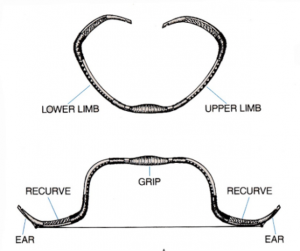
- All bows and crossbows will be tested using a standard set of scales, crossbows at full draw, and bows of all types at a draw of 28”/71.1cm. The draw weight at this distance must not exceed 30lbs/13.636kg with a small allowance for standard deviation in the set of scales being used.
- Arrow tag or tag arrows with screw on heads, IDV Engineering Mark 1 LARP arrows nor the dimple-headed ‘golf-ball’ style are suitable for use with this system. IDV Mark 2 arrows are acceptable.
- If the weapons check department is unsure of the construction of a home-made arrow, a Senior Weapons Checker may request that a sample be cut open in order to check the construction. If this is done, the Senior Weapons Checker will return the arrow to you, so that if the construction is called into question again, you will have a cutaway to show. Previously unseen moulded arrows will need to be subjected to more strenuous testing prior to being allowed to be used at our events.
- Arrow shafts must not exceed 28”/71.1cm from nock to the base of the arrowhead. The shaft must not splinter when lightly flexed or put under torsion. Shafts must be made of wood or fibreglass tube. Dowel, Metal and carbon fibre shafts are not acceptable.
- Bolt shafts length must be appropriate to the crossbow (there must be little space between the end of the shaft and the mechanism that projects the bolt, neither must the bolt be protruding inches past the bow when loaded), and no greater than 28”/71.1cm. Shafts must be made of wood or fibreglass tube. Dowel, Metal and carbon fibre shafts are not acceptable. The shaft must not splinter when lightly flexed or put under torsion.
- The nock (where present) must be securely attached to the shaft and must not be cracked or broken. It must hold the arrow securely against the bowstring.
- The fletching for arrows must be securely attached to the shaft either in a set of three – one perpendicular to the line of the nock and the remaining two set at 120° and 240° around the shaft from the first, or a set of four – one set at 30° to the line of the nock and continuing around the shaft at 150°, 210° and 330° to the line of the nock.
- The fletching for crossbow bolts must be securely attached to the shaft either in a set of two – both parallel to the line of the nock (if present), set on opposing sides of the shaft, a set of three – one perpendicular to the line of the nock (if present) and the remaining two set at 120° and 240° around the shaft from the first, or a set of four – one set at 30° to the line of the nock (if present) and continuing around the shaft at 150°, 210° and 330° to the line of the nock. Please note that triple fletched bolts must only be used with a crossbow designed to take them, those having a channel cut in the bolt groove for the fletching to run in.
- The head of an arrow, or crossbow bolt, must be at least 2”/51mm in diameter. There must be no sharp points, bodkins, broad heads, bullet tips or piles on the end of the arrow shaft even under the foam. The front face of the arrow must be made of upholstery foam at least 1”/25mm thick, which may have a hemispherical dome to improve its aerodynamics. Any latex, gaffer tape or other coverings around the outside of the foam must leave 1” of foam clear above it. The foam face must be securely attached to a piece of LD45 foam at least 1”/25mm thick. This must be backed by industrial rubber or leather (bicycle inner tube or boot leather tend to be sensible), no less than 0.125”/3mm thick. A piece of LD45 foam at least 1”/25mm thick with a hole to accommodate the shaft is then securely glued in place. The shaft is then securely glued to the rubber/leather pad and the sides of the hole in the foam. Behind this another 2-3”/5176mm LD45 foam must be glued to further support the shaft, this extra foam can be tapered or left as a cylinder.
- Example safe larp arrow/crossbow head: